









SafetySafety education
Implementation of safety education
At workplaces where hazardous materials are handled, we provide cautions and guidance through daily communication and regular meetings to prevent accidents. We also conduct education, always refining our teaching materials and methods. We further conduct safety training for all employees.
Study sessions
The Daiseki Group holds study sessions on specific themes and at specific times throughout the year, for all employees.
At workplaces where hazardous materials are handled, the study sessions feature more practical content.
The Daiseki Group holds monthly compliance study sessions for all employees, with a set theme each month. In FY2025, we thoroughly promoted awareness of the importance of checking, and developing the habit of pointing and calling.
Daiseki Group Safety Training*(FY2025)
| Time | Content | Total training hours | Number of participants |
|---|---|---|---|
| September | Importance of checking, and developing the habit of pointing and calling | 620 | 1,240 |
*Total safety training hours are included in total training hours at the Daiseki Group (FY2023)
Implementation of safety education
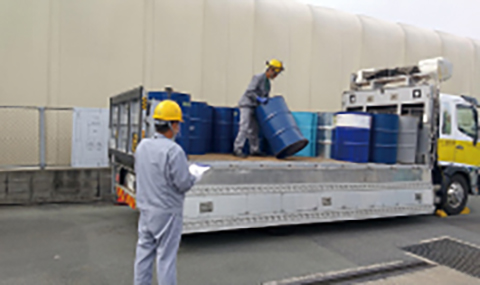
Hazardous materials course (Daiseki Hokuriku Works)
To prevent accidents, the Daiseki Group gives daily instructions and alerts at monthly safety meetings at worksites that handle hazardous materials. In addition, safety education is provided to all employees. For example, danger prediction training is conducted to enhance employees' ability to notice hazards anticipated at worksites. We also provide side-ride instruction to vehicle crews accompanied by an instructor, who checks and evaluates the state of vehicle driving and operations. Employees who received safety education gave feedback, saying that they understood the awfulness of accidents and points to focus on to prevent accidents.
Safety training video
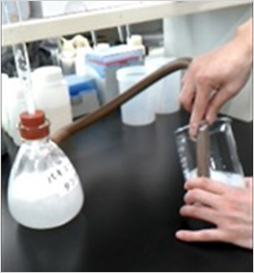
Picture from safety training video for prevention of leakage accidents
Daiseki conducts safety training utilizing videos. For example, in one video, the situation when a vacuum vehicle sucks wastewater that tends to foam is recreated in a lab setting and teaches how the addition of a defoaming agent suppresses the foaming. This video is used to train the vehicle staff.
First-aid training courses
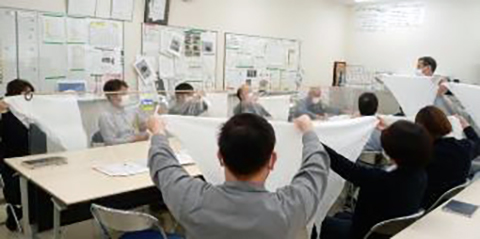
First aid training course (Daiseki Chiba Works)
In response to the risk of employees suddenly being injured or falling ill, Daiseki employees from the Safety Management Department who are experts in first aid go to each Works and provide first aid training (CPR for adults, AED use, foreign body removal, stopping bleeding, etc.). For example, participants learn the key points for calling 119 and learn practically how to perform chest compressions using training equipment, how to use an AED, and how to use a triangular bandage to stop bleeding. The focus is on preventing the condition of sick or injured persons from worsening in the event that an incident occurs.
Number of participants in Daiseki first aid training courses
| FY2025 |
|---|
| 289 |
Disaster drills
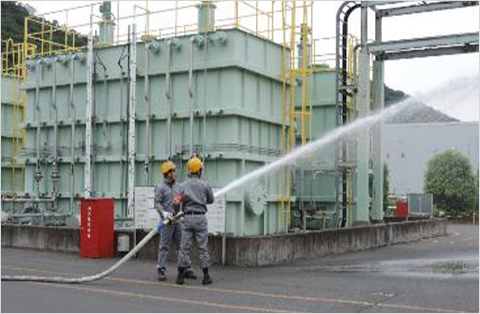
Disaster drill (Daiseki Nagoya Works)
Daiseki has hazardous material facilities at each of its Works and thoroughly manages the safety of those hazardous material facilities. To prepare for a potential major earthquake such as a Nankai Trough megathrust earthquake, we hold disaster drills assuming tsunami and fire scenarios at each Works every year.
| FY2025 |
|---|
| 615 |
Meeting on disaster/accident process analysis and recurrence prevention measures
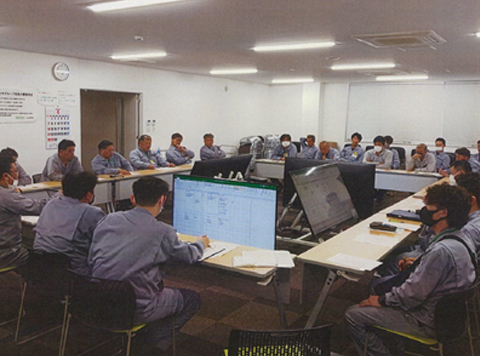
Meeting on process analysis and recurrence prevention measures (Daiseki Kyushu Works)
Previously, when a disaster or accident occurred, our main approach was to investigate the cause of the accident from the parties involved and implement countermeasures, so the situation was that similar accidents were likely to occur. To address this, in April 2024, we established a reporting system for when disasters and accidents occur. In this system, even small accidents and occurrences classified as minor incidents are to be reported to the Safety Management Department for disaster/accident process analysis.
In the process analysis, we investigate the true causes of accidents and disasters with consideration of a variety of factors. This includes human factors such as unsafe behavior, violations, and assumptions; material factors such as equipment, jigs, and tools; management system factors such as procedures and inspection methods; and other factors such as the work environment. After the analysis, a meeting on measures to prevent recurrence is promptly held and countermeasures against accidents are implemented. With regard to the disasters and accidents that occur at customer locations, we are working to reduce the number of accidents and disasters that occur by implementing accident countermeasures that include the customers.
Daiseki meeting on disaster/accident process analysis and recurrence prevention measures
| FY2025 |
|---|
| 975 people |
Health and safety supervisor training for foremen
Daiseki is providing employees who are site supervisors with the health and safety supervisor training for foremen. In order to prevent occupational accidents and illnesses at production sites, employees who have completed RST training act as lecturers and actively conduct in-house training for Assistant Division Chiefs (site supervisors) in the production departments that process the amount of incoming industrial waste received. Having employees who have completed the course serve as instructors makes it possible to set up training plans specifically for Daiseki, which leads to more effective health and safety supervisor training.
Number of participants in Daiseki health and safety supervisor training for foremen
| FY2025 |
|---|
| 12 people |